Greetings and welcome to all
the geographers, travellers and curious minds out there!
Following my introductory posts,
I'd like to provide you all with an overview of some basic concepts and
issues surrounding the environmental impacts of tourism. This shall largely draw upon some admittedly pretty old papers and concepts: Butler,1991; Wong, 2004; Sun and Walsh, 1998; Cohen, 1978 ; Buckley, 2000; and O’Reilly, 1986. However I think the seminal nature of several of these means they'll be a really useful backdrop to the more recent scene of tourism research which we'll delve into later. So without further ado – let’s get stuck in!
Why does tourism have detrimental environmental impacts?
In a perfect world, the tourism's economic benefits would be used to protect the very environment the industry
utilises to gain tourists. However in most cases, damage to the natural
environment occurs through unsuitable use of natural resources, threatening the
very economic viability of the industry (Butler, 1991). This occurs despite the
fact many tourists and governments acknowledge the need for protection of the
environment – but why?
A basic flaw is that tourism is
not naturally a non-consumptive renewable resource industry, with visitors
entering and leaving an area with no impact on the resources of that area
(Butler, 1991). If tourism goes beyond the capacity of an environment to endure
it, as with any other resource use, it becomes a short-lived boom and bust
industry (Murphy, 1985).
As such, tourism is essentially
cyclical in its development. The suggested tourist development model (Figure
1) follows 2 principles; that of the ‘product-life cycle’, and the
ecological concept of ‘carrying capacity’ (Butler, 1991). Regarding the first,
a product – in this case tourism – exhibits a stage of slow growth, and if
marketed right with the correct facilities, follows into a take-off stage of
fast growth with subsequent stability. What is being purchased here is an
experience (Butler, 1991). This is where the second principle of carrying capacity
comes in. This one is based on animal populations, which naturally experience
rapid growth until the population number goes beyond the environment’s
capability to sustain it, with subsequent population crashes. It can be argued
that tourist hotspots follow a similar course. Environmental capacity in this
case may be reflected in features such as water and land resources, and the
capability of plants and animals to withstand disturbance (Butler, 1991). The
definition of carrying capacity within a tourist context varies greatly, but for
the purposes of this model I think the most appropriate definition is a
biophysical one proposed by Mathieson and Wall, 1982: 21. Here, carrying capacity is defined as the maximum tourist numbers able to visit a site whilst avoiding a significant change in the natural environment and the visitors’ quality of experience.
Ultimately the model proposes that destinations will be deemed less attractive to visit with increasing degradation of the environment – a period of decline. After this, the tourist destination may return to its original purpose, or find alternative purposes such as a retirement community – the rejuvenation period (Butler, 1991).
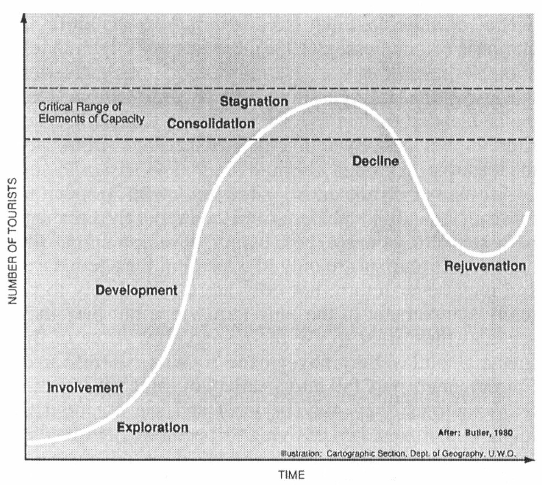
Figure 1. Tourist-area cycle of evolution, based on
Butler, 1980. Source: Butler, 1991.
Both
principles suggest an inevitable overstretching of the environmental capacity –
the ‘Tragedy of the Commons’ (Hardin, 1968) - in a tourist context that is. This concept helps to explain exactly why tourist
development more often than not leads to environmental degradation. Most
resources for tourism are ‘common’ goods – the natural landscape, for example.
These are inevitably destroyed due to the fact that each individual stands to
benefit - in the short term at least - by purposefully exceeding the limits or
capacity of that resource (Butler, 1991). This leads to growth of tourism
characterised by strong competition to gain a share of the expanding market with
little thought given to the implications, including that on the natural
environment.
Categorising Tourism's Environmental Impacts
Figure 2 identifies some basic environmental impacts of tourism:

Figure 2. A summary of the detrimental environmental
impacts of tourism, adapted from Genot, 1997; Wong, 2002. Source: Wong, 2004.
Tourism’s environmental impacts
cover pretty much all parts of the natural environment. They vary from
comparatively obvious effects such as sewage wastewater discharges, to impacts
that are much more subtle and more difficult to detect, such as modifications
in plant pollination (Buckley, 2000). However, these more subtle ones are often
more critical for conservation than the more obvious impacts. Let’s have a look
at a subtle impact from Figure 2 in more depth: soil erosion. Although not
exactly what would first spring to mind when thinking about polluting tourists,
soil erosion can lead to changes in plant communities and regeneration, cause
particulate pollution, cause changes in stream turbulence and current speed and
alter surface water infiltration (Buckley, 2000).
Tourism’s environmental impacts
exhibit distinctive geographical patterns (Mieczkowski, 1995). Globally, the main areas focus in Western Europe, with The Mediterranean being the most overdeveloped region worldwide in terms of tourism (Wong, 2004).
However, there are spatial discontinuities in the impacts; although the
majority of tourist activity is extremely localised, the impacts can be experienced across long distances, as with air pollution for example. Furthermore, the
intensity of impacts is further complicated by their varying temporalities,
namely seasonality (Wong, 2004). Although theoretically seasonality provides a
gap for the environment to recover from tourists, impacts can take place in
varying dimensions (Wong, 2004). For example, they can be temporally and
spatially cumulative, building up slowly and leading to longer-term intense changes
that are often not noticed until too late. For example, touristic air and road
transport adds to global climate change through air pollution, affecting
tourism detrimentally particularly in alpine sites and small islands (Wong, 2004).
As a final point, it should be noted that
it is often tricky or even impossible to separate tourism’s impacts solely from separate anthropogenic
activities, as well as denote cause and effect relationships (Butler, 2000).
End Notes
Phew! After all that, I expect
you need a cup of tea and a lie down... To summarise, my main points are that tourism can be conceptualised as a cycle, in which environmental degradation is inevitable - unless stringent management steps are taken to prevent this. The environmental impacts of tourisms exhibit strong geographical, spatial and temporal patterns, and there have been various attempts to classify these and their intensity.
Hope you all feel slightly more enlightened
after this post, and do drop me a comment with any thoughts/questions! :)
